


















































 Order now!
 You're shopping anyway...



 By: Gary Kane
Article Copied from AKC News April 20, 2015
Your Bichon Frise leaps into your lap, settles in, and gazes adoringly into your eyes. He seems blissfully content. You cannot help but smile at him.
This feel-good interaction between you and your Bichon might begin with that gaze and point to a powerful biological mechanism that fuels the loving bond between man and dog, according to a report in the journal Science.
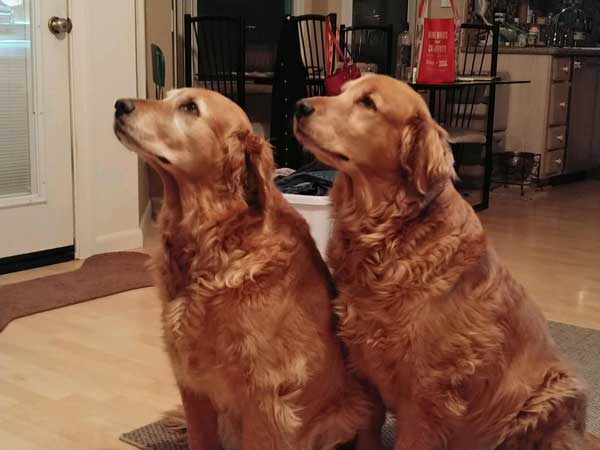
Researchers in Japan found that when dogs focused a prolonged gaze on their owners the dogs experienced elevated levels of oxytocin, a hormone produced in the brain that is associated with bonding and nurturing, similar to that between parent and child. The owners on the receiving end of those gazes also experienced a boost in their levels of oxytocin.
The researchers, led by Dr. Miho Nagasawa of the department of animal science at Azabu University, refer to this mutual feedback between man and dog as an "oxytocin-gaze positive loop." What that means, essentially, is that your dog's gaze makes you feel loved and your response -- a smile, a returned gaze, a caress -- makes your dog feel cherished.
The researchers measured the oxytocin levels in the urine of 30 dogs and their owners before and after they interacted. The dogs, males and females, included Golden Retrievers, Dachshunds, Poodles, a Jack Russell Terrier and a few mixed-breed dogs. Measurements showed that increases in the oxytocin were greatest in dogs who gazed at their owners for prolonged periods, which researchers defined as 100 seconds in the first five minutes of the encounter. Breed or sex has no significant influence on the changes in oxytocin levels.
In a second phase of their study, the researchers applied nasal sprays of oxytocin or saline to the dogs. Each dog was brought into a room with its owner and two strangers. The female dogs given a dose of oxytocin gazed longer at their owners, who in turn experienced a boost in their oxytocin levels. The researchers were at a loss to explain by the sex of the dog influenced the outcome, but speculated that male dogs were more protective of their owners with strangers in the room and less inclined to focus their gaze.
Evan MacLean, a researcher at the Canine Cognition Center at Duke University, wrote in a separate article in Science that the findings of Nagasawa and his team could have far-reaching implications.
"In addition to providing clues about how dogs became a part of human history, the results also help to elucidate the proximate mechanisms through which our relationships with dogs may be salubrious," he wrote. "For example, the benefits of assistance dogs for individuals with autism or posttraumatic stress disorder -- conditions for which oxytocin is currently being used as an experimental treatment -- may arise partly through these social pathways.
"In the meantime, Nagasawa (and his team) have provided more evidence that when your dog is staring at you, she may not just be after your sandwich."